A beautiful t-shirt with a colorful mandala, a favorite symbol of Buddhists. In various spiritual traditions, mandalas may be employed for focusing attention of practitioners and adepts, as a spiritual guidance tool, for establishing a sacred space and as an aid to meditation and trance induction. In the Eastern religions of Hinduism, Buddhism, Jainism and Shintoism it is used as a map representing deities, or specially in the case of Shintoism, paradises, kami or actual shrines.
In New Age, the mandala is a diagram, chart or geometric pattern that represents the cosmos metaphysically or symbolically; a time-microcosm of the universe, but it originally meant to represent wholeness and a model for the organizational structure of life itself, a cosmic diagram that shows the relation to the infinite and the world that extends beyond and within minds and bodies.
A beautiful t-shirt with a colorful mandala, a favorite symbol of Buddhists. In various spiritual traditions, mandalas may be employed for focusing attention of practitioners and adepts, as a spiritual guidance tool, for establishing a sacred space and as an aid to meditation and trance induction. In the Eastern religions of Hinduism, Buddhism, Jainism and Shintoism it is used as a map representing deities, or specially in the case of Shintoism, paradises, kami or actual shrines.
In New Age, the mandala is a diagram, chart or geometric pattern that represents the cosmos metaphysically or symbolically; a time-microcosm of the universe, but it originally meant to represent wholeness and a model for the organizational structure of life itself, a cosmic diagram that shows the relation to the infinite and the world that extends beyond and within minds and bodies.


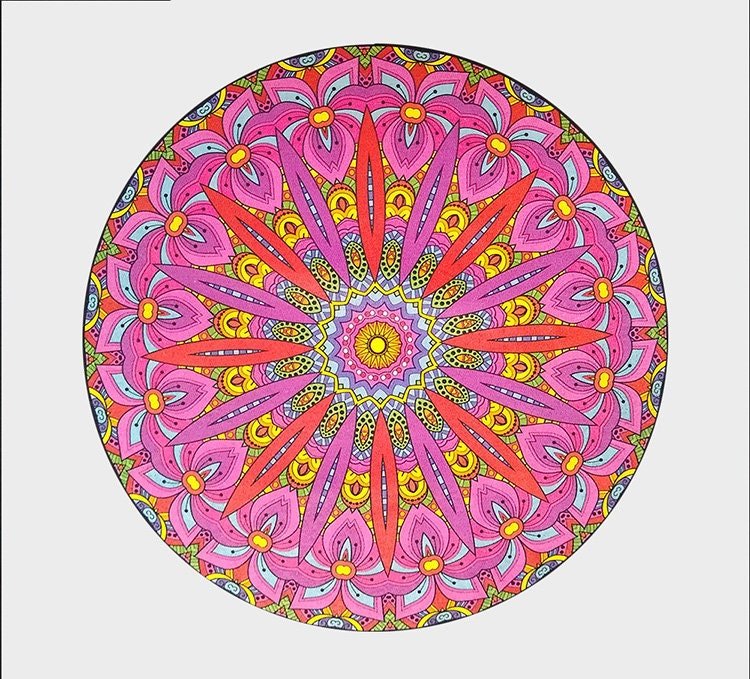 Image 1 of 2
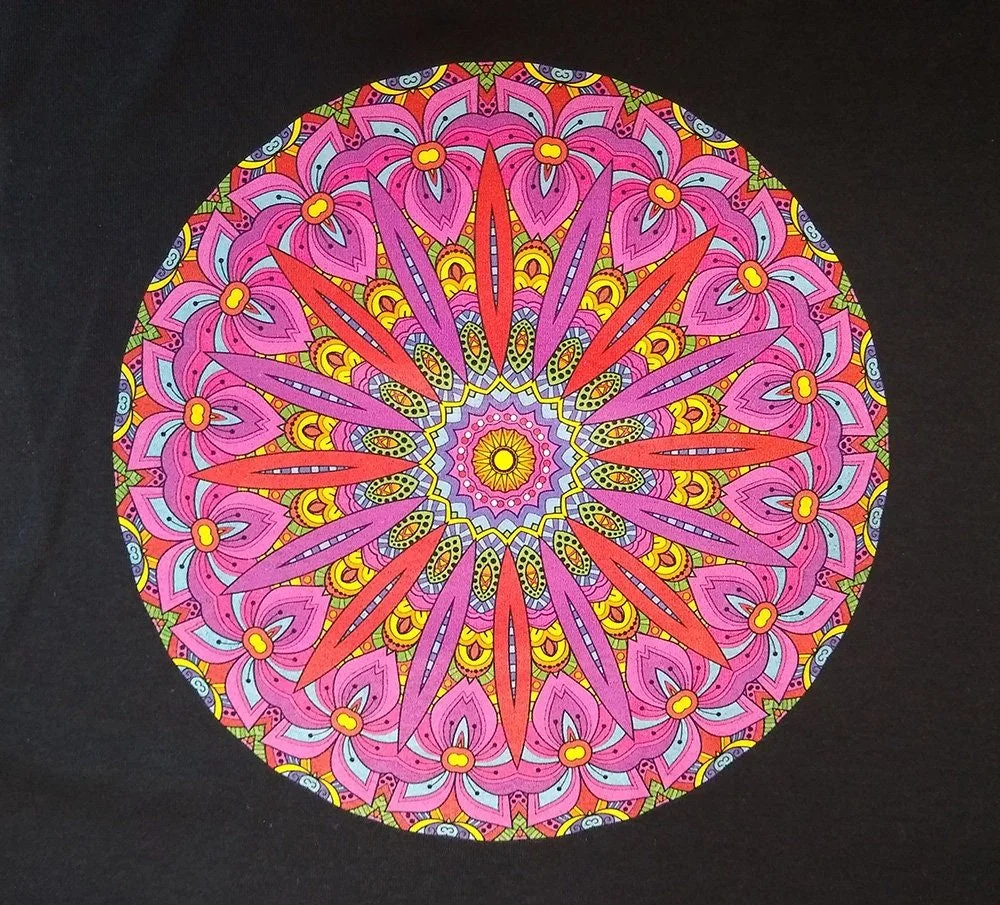 Image 2 of 2